

What is a Self-Aligning Ball Bearing? Uses & Series (2026)
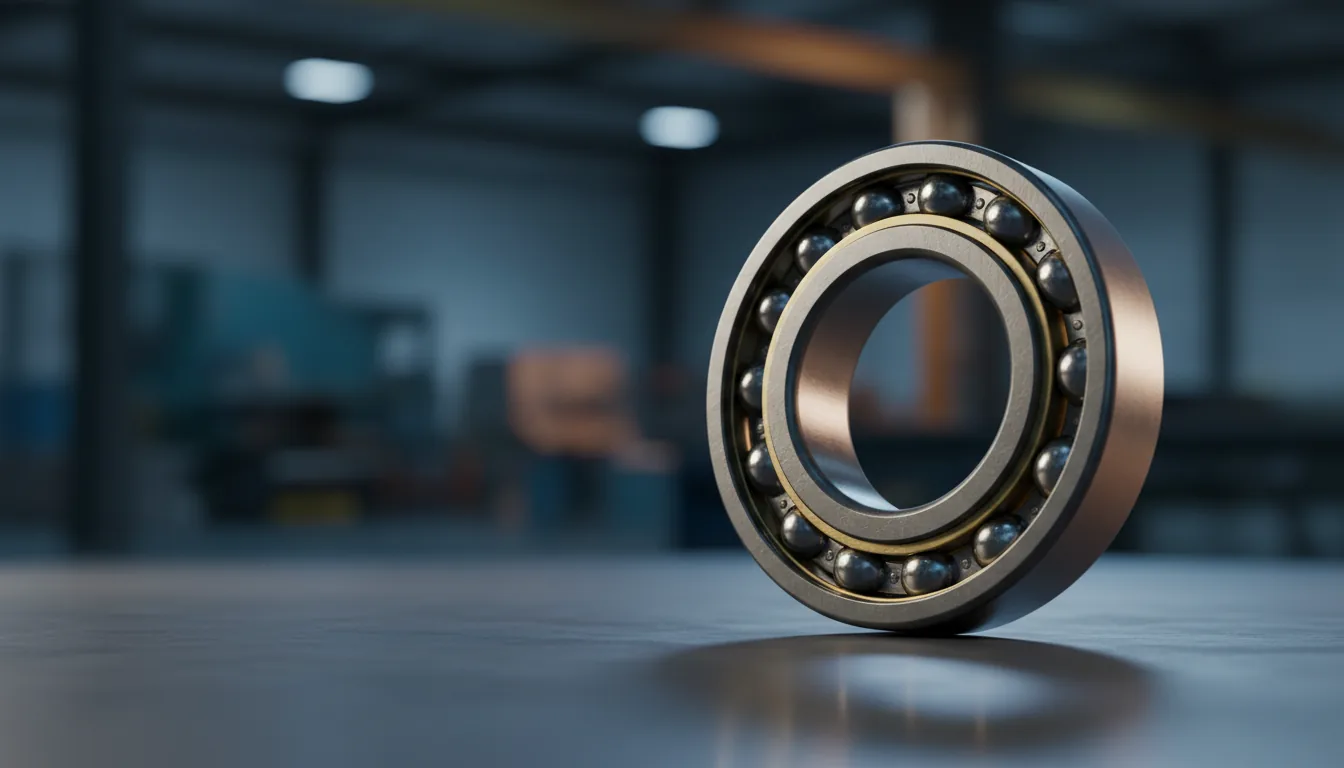
A self-aligning ball bearing is a specialized industrial component, including the 1200 and 2200 series, designed to automatically accommodate shaft misalignment without increasing friction[1][2]. Choosing the right bearing type is the first reliability decision for any machinery setup, as each type exists for a specific load and motion profile. You have likely seen the 1200, 1300, 2200, or 2300 series number stamped on components a hundred times. These are not interchangeable with standard deep groove bearings; they are engineered specifically to prevent premature bearing failure when shafts deflect or housings flex under load[3][4]. For industrial buyers and maintenance engineers in Pakistan, understanding when to deploy these specialized bearings is critical for reducing downtime. This guide explains what a self-aligning ball bearing does, its key series, and exactly when your machinery requires one.
What is a self-aligning ball bearing and how does it work?
A self-aligning ball bearing is a specialized industrial component, including the 1200 and 2200 series, designed to automatically accommodate shaft misalignment without increasing friction[5][1]. While many believe all bearings are basically interchangeable, a self-aligning bearing features a unique geometry: it uses two rows of balls and a common sphered raceway in the outer ring[2][6]. This concave spherical raceway allows the inner ring, balls, and cage assembly to pivot together, tolerating angular misalignment between the shaft and housing without binding or creating edge loads[1][2].
The primary advantage of this design is its ability to handle shaft deflection and mounting errors while maintaining an exceptionally low coefficient of friction. In fact, non-sealed self-aligning ball bearings have the lowest friction of any rolling bearing type, often measuring around 0.0010 to 0.0018[7][8]. This allows them to run cooler at high speeds even when the shaft is not perfectly aligned. Depending on the specific design and series, they can accommodate permissible dynamic misalignment of 4° to 7° under normal loads[9].
Choosing the right type is the first reliability decision for any machinery setup, as each type exists for a specific load and motion profile. Because the contact angle is small, these components have low axial load capacity and are best suited to radial load applications[9][10]. When a standard bearing is subjected to these same misaligned conditions, the ball path becomes non-ideal, forcing the load onto a narrow raceway band, which rapidly increases heat and fatigue[11][12]. By deploying self-aligning ball bearings, engineers ensure that dynamic flexing does not compromise the mechanical integrity of the system, ultimately extending the operational lifespan of the entire rotating assembly.
What is the difference between the 1200, 1300, 2200, and 2300 bearing series?
The self-aligning category features four primary series - 1200, 1300, 2200, and 2300 - each engineered to handle specific radial loads and motion profiles. For the same bore size, the 1200 and 1300 series act as the narrow self-aligning bearing series, while the 2200 and 2300 are the wide and extra-wide versions, respectively[13][14]. The 2200 and 2300 series feature wider inner rings and higher load ratings compared to their 1200 and 1300 series counterparts[15][16].
This structural difference in width dictates the internal geometry and the resulting basic dynamic and static radial load capacities. A wider cross-section provides more internal space for the ball set and raceway support, increasing the contact area and the radial load-carrying capacity[17][18]. However, this increased capacity comes with a larger envelope and slightly higher mass, meaning engineers must balance load requirements against available housing space.
| Width Class | Series | 10mm Bore Dimensions (d × D × B) | Dynamic Load Rating (lbf)* | Static Load Rating (lbf)* |
|---|---|---|---|---|
| Extra Narrow | 1200 Series | 10 × 30 × 9 mm[19][15] | 989[15] | 216[15] |
| Narrow | 1300 Series | 10 × 35 × 11 mm[15] | 1304[15] | 288[15] |
| Wide | 2200 Series | 10 × 30 × 14 mm[15] | 1331[15] | 288[15] |
| Extra Wide | 2300 Series | 10 × 35 × 17 mm[16] | 1620[16] | 459[16] |
(Note: Catalog ratings are basic reference figures; actual permissible working loads depend on speed and lubrication factors[17][20].)
Understanding these dimensional variations is crucial when sourcing replacements or designing new equipment. While all four series provide the essential self-aligning function, selecting the correct width class ensures the component can endure the specific radial forces applied by the machinery without premature fatigue.
What are the primary self-aligning ball bearing uses in Pakistan?
Self-aligning ball bearings are the required choice for agricultural machinery and textile equipment in Pakistan when shaft deflection or mounting errors make standard bearings fail[3][4]. In these demanding industrial environments, structural flexing is a constant reality. HI-TEC Bearings Pakistan supplies the complete range of self-aligning ball bearings, allowing buyers to source all 1200 to 2300 series components from one reliable brand.
Standard deep groove ball bearings are designed for perfectly aligned shafts; when misaligned, they suffer uneven ball loading, localized stress, and severe edge loading that drastically cuts their fatigue life[21][12][22]. In contrast, self-aligning variants absorb these dynamic shifts. Here is how they are practically applied in local industries:
- Agricultural Harvesters and Tractors: Field conditions and uneven terrain cause constant chassis flex and shaft deflection in agricultural machinery. Self-aligning bearings accommodate this dynamic misalignment - up to 3° in open designs - preventing the sudden mechanical failures that halt harvest operations[23].
- Textile Spinning Frames: Long shafts in textile mills are notoriously difficult to align precisely across multiple housing supports. The self-aligning capability compensates for static mounting errors, ensuring smooth, low-friction rotation that prevents excessive heat buildup and fire hazards[4][24].
- Heavy Industrial Conveyors: Conveyor systems often experience housing deformation under heavy, uneven bulk loads. By utilizing 2300 series bearings, these systems maintain rotational integrity even when the supporting framework bends[3][25].
- Industrial Fans and Blowers: High-speed applications prone to minor shaft whip rely on the exceptionally low friction of these bearings (0.0010 to 0.0018 coefficient) to maintain cooler operating temperatures despite slight angular offsets[7][8].
To ensure your machinery operates reliably despite structural flexing, contact us today to consult with our technical team in Pakistan.
Frequently Asked Questions
What is a self-aligning ball bearing?
A self-aligning ball bearing is a specialized industrial component, including the 1200 and 2200 series, designed to automatically accommodate shaft misalignment without increasing friction[1][2]. It utilizes two rows of balls and a spherical outer raceway to allow the inner assembly to pivot freely[6].
What are self-aligning ball bearing uses?
Self-aligning ball bearings are the required choice for agricultural machinery and textile equipment in Pakistan when shaft deflection or mounting errors make standard bearings fail[3][4]. They are used wherever structural flexing or long, difficult-to-align shafts are present[26].
Which bearing is best for shaft misalignment?
The self-aligning ball bearing is optimal for angular shaft misalignment, accommodating dynamic deflections of 4° to 7° depending on the specific series and load[9]. Standard deep groove bearings fail under these conditions due to severe edge loading[12].
What is the difference between the 1200 and 2200 bearing series?
The 1200 series is an extra-narrow self-aligning bearing, while the 2200 series is the wide version for the same bore size[13][14]. The wider 2200 series provides more internal space for the ball set, resulting in higher radial load capacities[15][17].
References
- Self-Aligning Ball Bearings. https://cdn.skfmediahub.skf.com/api/public/0901d19680208482/pdf_preview_medium/0901d19680208482_pdf_preview_medium.pdf (2026-03-30)
- Intrdductidn to Ball Bearings. https://ntrs.nasa.gov/api/citations/19810009867/downloads/19810009867.pdf (2025-11-29)
- Self-Aligning Ball Bearings: inform yourself & order online .... https://medias.schaeffler.us/en/plp/SelfAligningBallBearings (2026-07-23)
- Self-Aligning Ball Bearings | NSK Americas. https://www.nsk.com/am-en/products/bearings/ball-bearings/self-aligning-ball-bearings/ (2024-07-02)
- Self Aligning Ball Bearings - an overview. https://www.sciencedirect.com/topics/engineering/self-aligning-ball-bearings (2025-09-27)
- Self-Aligning Ball Bearings. https://www.ntnglobal.com/en/products/catalog/pdf/2203E_b05.pdf (2026-01-02)
- Why buy this bearing. https://www.efox.ie/PDF%20Catalogues/SKF/Bearing%20Data%20PDFs/Self-aligning%20ball%20bearings%204847%20E.pdf (2025-03-17)
- 6000 EN 03 SABB. http://www.bearing.net.au/wp-content/uploads/2018/02/6000_EN_03_SABB.compressed.pdf (2024-12-22)
- Self-Aligning Ball Bearings. https://www.nsk.com/products/ball-bearings/self-aligning-ball-bearings/ (2024-07-11)
- NACHI Bearing Catalog - Technical Information. https://nachi-tool.jp/bearing/pdf/Tech.pdf (2026-07-07)
- Bearings & their Failures (Part II) - Fibre2Fashion. https://www.fibre2fashion.com/industry-article/6309/bearings-and-their-failures (2012-06-11)
- Bearing Failure Root Cause Analysis: Beyond the Obvious - Dovient. https://dovient.com/resources/academy/bearing-failure-root-cause-analysis (2026-02-05)
- BEARING AND LINEAR REFERENCE GUIDE. https://www.nsk.com/content/dam/nsk/am/en_us/documents/bearings-americas/Bearing-and-Linear-Reference-Guide.pdf (2026-07-22)
- Bearing-and-Linear-Replacement-Guide.pdf. https://www.nsk.com/content/dam/nsk/am/en_us/documents/bearings-americas/Bearing-and-Linear-Replacement-Guide.pdf (2025-02-25)
- Contents - McGuire Bearing Company. https://www.mcguirebearing.com/wp-content/uploads/2014/05/2014AxisCatalog.pdf (2026-07-09)
- Self aligning ball bearing 2200 series,2300 series - sws bearing ltd. https://www.sws-bearings.com/product-bearing/self-aligning-ball-bearing/2200-series-2300-series/ (2023-03-14)
- Engineering Handbook. https://help.bdsbearing.com/hubfs/Knowledge%20Base/MRC/MRC%20Bearing%20Services%20Engineering%20Handbook.pdf (2026-07-29)
- High-Speed Mounted Bearings for Heavy-Load Applications. https://ibtinc.com/learn/high-speed-mounted-bearings-heavy-load-applications/ (2026-05-13)
- hain kets hain kets. https://www.finerpt.com/site/DefaultSite/filesystem/documents/Catalogues/Premium%20Bearing%20Range%20Book%202.pdf (2025-10-05)
- Technical Report. https://www.nsk.com/content/dam/nsk/common/catalogs/ctrgPdf/bearings/e728.pdf (2025-01-27)
- What Are the Common Causes of Failure in Deep Groove Ball .... https://www.wtoo.com.cn/news/industry-news/what-are-the-common-causes-of-failure-in-deep-groove-ball-bearings.html (2024-05-13)
- Troubleshooting Common Issues with Deep Groove Ball .... https://www.slsbearings.com/cn-en/blog/troubleshooting-common-issues-with-deep-groove-ball-bearing (2024-08-08)
- PM PV IS M EA P X 5 v1 | 2012-05-31. https://cdn.skfmediahub.skf.com/api/public/0901d1968036f72f/pdf_preview_medium/0901d1968036f72f_pdf_preview_medium.pdf (2025-08-10)
- Kg-sabb - Self Aligning Ball Bearings. https://www.kgbearing.com/pd/self-aligning-ball-bearings/ball-bearing/Kg-sabb (2025-09-01)
- [PDF] Self-aligning ball bearings. https://landvelar.is/wp-content/uploads/2021/01/SKF_Self-aligning-ball-bearings.pdf (2026-06-07)
- There is problem of alignment in deep groove ball bearings. https://www.niushangcn.com/resources/there-is-problem-of-alignment-in-deep-groove-ball-bearings.html (2026-01-17)